In September 2025, we went live with Phase 1.0 of our Reliable Power Microgrids (RPMs).
There have been several iterations to that phase that we deployed since. For example, in March 2026, we migrated to a locally sourced Smart Meter whose registers the vendor willingly made available to us for integration with our own software stack rather than being locked into their proprietary stack. This was also a huge milestone, Phase 1.5 if you will.
As a refresher, here’s our four phase microgrid cultivation blueprint to get a sense of the goals of each phase.
However this post is mostly about a major iteration from Phase 1 – Sub metering to Phase 2 – Backup but I will highlight iterations of phase 1 that I did not get a chance to share about earlier.
The main change here is that we have deployed battery capacity that serves as a backup during grid outages. For the rest of this update, I will follow a similar format to the first one.
Metering 2.0
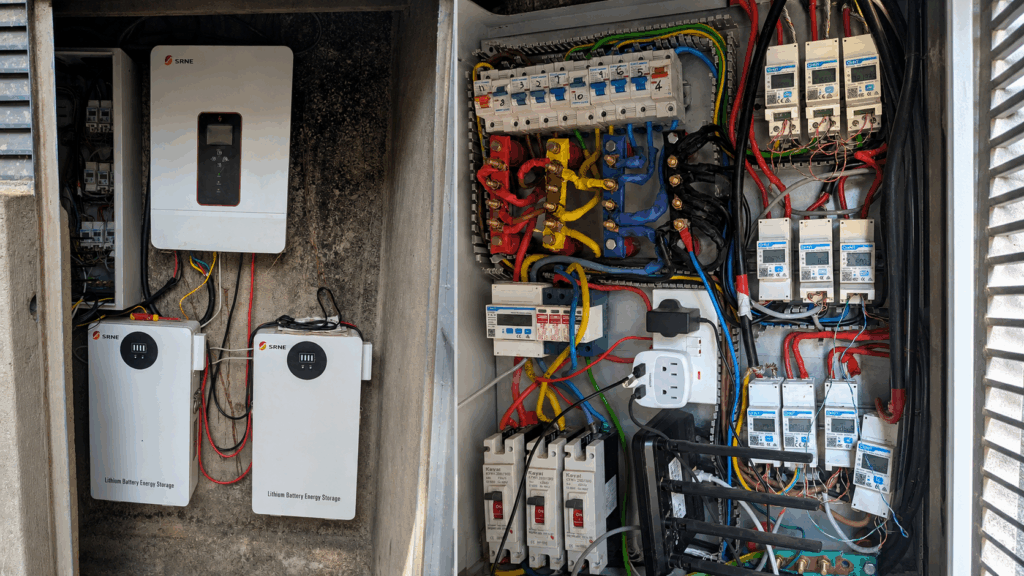
As of March 2026, we decommissioned the wirelessly connected Calin Meters and deployed the wired (RS485) Chint Smart meters. The connectivity to these has been more reliable for two reasons.
- Wired communication is less vulnerable to wireless interference and far cheaper for meters that are already clustered in a single location.
- We now control the software (OpenEMS) that is communicating to the meters.
To achieve the integration with OpenEMS, we made our first contribution to the open source project by writing the drivers for both three and single phase Chint Meters. We are very proud of this contribution.
Storage 2.0
We deployed two 5.12 kWh LFP batteries and a 12 kW three phase hybrid inverter manufactured by SRNE. This was locally sourced, we learned our lesson with the smart meters. Ideally, this site would be best served with a 15 kWh or 20 kWh battery pack but we have to start from somewhere and our partners over at Energy IoT were able to donate the 10 kWh battery pack so we made use of that.
To achieve the integration with OpenEMS, we also wrote drivers for the SRNE hybrid inverter. That driver is still under testing and review by the maintainers and is yet to be published to the main project. You are still welcome to test and inspect it via NFE’s OpenEMS fork.
Tech Stack
Metering: Din rail mounted. DDSU666 – Single phase and DTSU666 – Three phase.
Connectivity: Daisy chain connection with twisted pair wires to RS485 (A&B) meter terminals via Modbus RTU interface to a Raspberry Pi 4B connected to LTE wireless internet router.
AMI: OpenEMS
Communication: Whatsapp for customer support and email for system notifications. NFE customer app for realtime meter readings for customers.
Billing: Invoicing managed via Energy IoT’s Metering and Billing Engine. VAT reporting done via EFRIS. Monthly postpaid payments via Pesapal (Mobile Money, Visa/Mastercard).
Finances: We are tracking our spending and inflows (contributions and income) via Open Collective here and internally via Zoho accounting software.
Documentation: Most information about this microgrid is available on our public Wiki here.
Present Challenges
Funding this work has been tough, applying for grants has not yet yielded the results we expected. We are exploring debt financing as well as equity. These funding challenges have also delayed our expansion to more customers.
Next Release: Phase 3
Backup to Backbone: We are ready to add solar capacity (and probably battery capacity) so that we can make solar + battery the main power source for this community and have the grid as a secondary source. This change would move the economics of operating this microgrid from the current 10% to 20% monthly margins to 40% to 55% which would allow the project to break even in about 3 years on storage assets that will last 15 to 20 years.
CRM: We are currently undecided here, we see the value a mature project like MPM offers while we also appreciate the rapid growth of MBE and its narrower focus on products like ours. We are yet to decide which one we’ll stick with but either way, we are glad to have open source options and will seek to integrate either of them with EFRIS soon.
Metering 2.5: We currently don’t have a way to remotely shut power on/off which creates additional costs for a postpaid billing model and blocks the possibility of supporting prepaid billing soon. We’d like to integrate an off the shelf locally sourced smart relay to effect this. Our experiments at Open Energy Hackathon 2.0 showed us that this is very feasible.
The Team
- All this was made possible by the dedicated team at NFE. Dansturn, Hillary, Daphine, and Dismas, thank you.
- Our partners at Energy IoT also funded Phase 2 and were the brains behind MBE. Alejandro, Arila, Guru, Redwan and all the other volunteers, you have been phenomenal. Thank you so much
- The folks at IEEE Smart Village, OSEA and EnAccess, USEA, thank you for all the support.
For more on this project, you can connect with the NFE team via our public channel on Matrix or receive our quarterly progress updates via our community mailing list.
You can also make contributions to the project to support phase 2 via Open Collective here.
Leave a Reply