Category: Technology

  • Client story: Sezibwa Rentals, Nansana

    Client story: Sezibwa Rentals, Nansana

    Since late August 2026, the 10 homes at Sezibwa Rentals have kept their lights on through about 90% of the hours the grid was down. NFE got there in phases on the site’s existing grid connection: smart meters first, then a shared battery, then rooftop solar.

    The challenge

    Sezibwa Rentals is a compound of 10 rental homes in Nansana, Wakiso, on the UEDCL grid. Between 25 August and 8 November 2026, the grid supply there failed 86 times, for 128 hours in total: about 1.7 hours a day. Most cuts lasted under an hour, and the longest ran six hours. Tenants reported 7 to 20 hours of unplanned cuts a week, and NFE’s monitoring measured about 12. Some cuts took out only one or two of the three phases. Without backup, tenants felt every one of those cuts, at home, at work and at study.

    What NFE did: grow the microgrid in steps

    NFE’s microgrid cultivation model adds one layer at a time, so the community takes on cost and change gradually and each step is proven with data before the next. Sezibwa moved from Monitor to Backup, and solar now starts the step toward Backbone.

    WhenStepWhat changed for the site
    Jun 2025AgreementMemorandum of understanding signed with Sezibwa Rentals
    Sep 2025Phase 1: MonitorOne UEDCL commercial time-of-use meter for the site, with an NFE smart meter in each of the 10 homes and monthly NFE billing
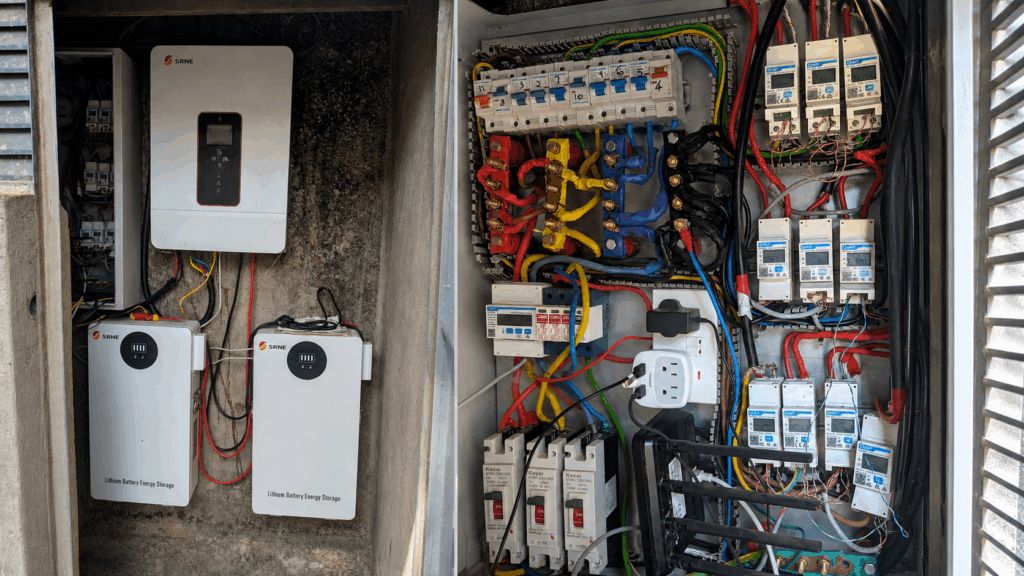
    Late Jul 2026Phase 2: BackupA 10 kWh battery and a hybrid inverter keep the homes powered through grid cuts. NFE’s open-source controller (OpenEMS) monitors the site around the clock
    26 Sep 2026Smart chargingThe battery charges at the cheap night rate and powers the homes through the expensive evening peak
    26 Oct 2026Phase 3: Solar4.8 kWp of rooftop solar refills the battery during the day
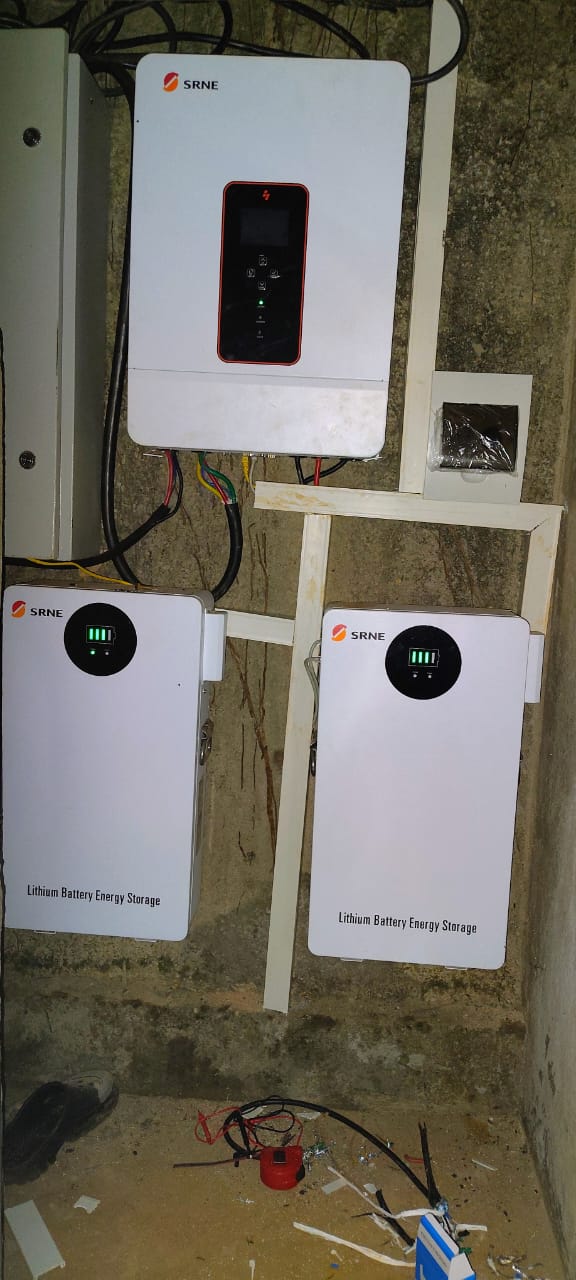
    The site’s hybrid inverter and lithium battery storage

    Results: residents kept power through 90% of grid outage hours

    In September and October 2026, the grid was down for 109 hours. Residents lost power for about 10 of them. In October, the battery carried the homes through 96% of 77 outage hours, including a six-hour night cut on 11 October that it covered with 60% charge left.

    With solar and the new controller settings, NFE is targeting 99% coverage. The last few days have been at 96–100%.

    Month (2026)Grid outagesGrid down (hours)Residents without power (hours)Outage hours covered
    September16327.178%
    October48772.996%
    Total, Sep – Oct6410910.091%

    Source: NFE’s OpenEMS monitoring at the site, grid-side and home-side voltages every 5 minutes. Residents’ outage hours are estimated from times the home supply and the site controller went dark during a grid cut or with the battery empty.

    Other gains

    • Backup energy: from 26 September to early November, the battery supplied about 96 kWh to the homes during grid cuts.
    • Cheaper evenings: over 40 nights, the battery moved 183 kWh of the site’s use from the evening peak to the night rate, saving about UGX 34,500 on the bulk power bill.
    • Solar: since 26 October, the panels refill the battery by late morning. The grid’s night top-up fell 42% in the first days, and the best days so far produced 13–15 kWh.
    • Residents adapted: tenants began telling each other when the site switched to battery, so everyone eased off heavy appliances and the backup lasted longer.

    What we learned and fixed

    Every hour residents lost power has a cause in the data, and each one changed how NFE runs the site.

    • Phase balance (27 Sep): in a cut that started at 05:05, the battery carried the homes for three hours, then the inverter tripped with 67% charge left. Heavy appliances were concentrated on one phase. NFE rebalanced which homes sit on each phase, moving the heaviest users onto different phases.
    • Settings that think (29 Oct – 5 Nov): while testing a solar-first setting, the battery ran down to its reserve before evening cuts, and homes lost power for up to two hours. NFE is replacing fixed settings with a controller that plans each day from the weather forecast and recent outages. Its first rule: residents never lose power.
    • Measure first: every decision above came from the site’s own data. The same data lets NFE size the next site, and show a new client what the grid really delivers before anything is installed.

    For the technical detail behind each step, see the go-live posts for Phase 1.0, Phase 2.0 and Phase 3.0, and our microgrid cultivation blueprint.

  • Go-live: Pilot at Sezibwa Rental Homes, Phase 3.0

    In September 2025, we went live with Phase 1.0 of our pilot at Sezibwa Rental Homes: smart sub-meters and NFE billing for 10 homes on one UEDCL commercial meter. In late July 2026 came Phase 2.0, a 10 kWh battery and a hybrid inverter that keep the homes powered through grid outages. On 26 October 2026, we connected Phase 3: 4.8 kWp of rooftop solar.

    As a refresher, our microgrid cultivation blueprint grows a microgrid one layer at a time: Monitor, Backup, Backbone, then Community Power Plant. Each step is proven with data before the next. In the Phase 2 post, we said we were ready to add solar so that solar plus battery could become this community’s main power source, with the grid as the backup. This release is the first step on that road. We are not at Backbone yet, and I’ll explain why below. As before, I’ll follow the same format.

    Smart charging (Phase 2.5, if you will)

    One iteration of Phase 2 is worth sharing first. Since 26 September 2026, the battery charges at the cheap night rate and powers the homes through the expensive evening peak. Over 40 nights it moved 183 kWh of the site’s use from the evening peak to the night rate, saving about UGX 34,500 on the bulk power bill.

    Solar 1.0

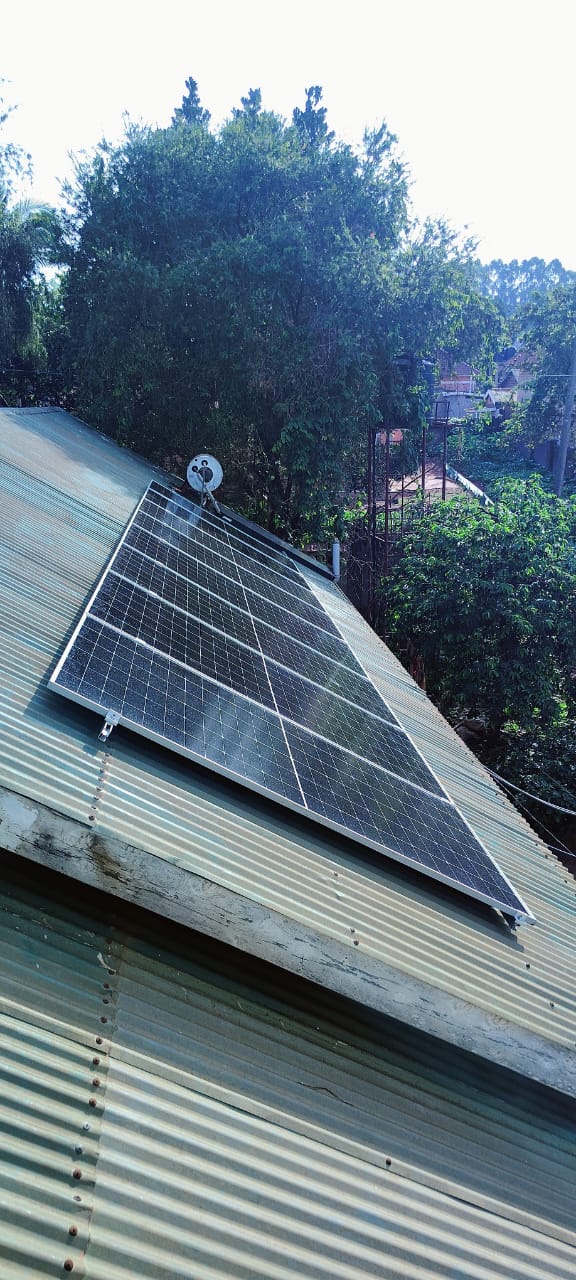
    We installed eight 600 W panels in a single row on the north-west face of the roof. Sezibwa sits less than half a degree north of the equator, so the sun is almost overhead all year and the direction a roof face points makes little difference: modelled output for the four faces differs by only about 2%. The trees decided it. Tall trees stand on most sides of the house, and the north-west face looks away from most of them.

    All eight panels are wired in one series string into the SRNE hybrid inverter we installed in Phase 2. Two strings of four would have run at about 155 to 180 V, below the inverter’s 200 V minimum, so one string it is. The trade-off is that shade on one panel pulls down all eight, so Dismas cleared the vegetation around the array. At commissioning on the afternoon of 26 October, the string read 379 V with no load: all eight panels in series and none connected backwards.

    Solar panels mounted on a corrugated iron roof at Sezibwa Rental Homes in Nansana, with tall trees behind
    The new solar array on the north-west face of the roof at Sezibwa Rental Homes, Nansana. Photo: Dismas, NFE.

    What should it produce? Our model for this roof gives about 19.5 kWh of solar on an average day (15 to 18 kWh in rainy weeks), or about 6,780 kWh a year. The homes use about 28 kWh a day, measured from 19 to 25 October, so solar alone can’t run the site. The plan is for solar to serve the homes during the day and fill the battery, for the battery to carry the evening peak, and for the grid to top up at the cheap night rate. On a good day, we expect solar and battery together to supply about 65% of the load.

    First results

    • The first two days were cloudy. The panels produced 4.5 kWh on 27 October and 4.6 kWh on 28 October, well below plan. The best days up to 2 November produced 13 and 15 kWh, against 12 to 18 kWh expected in the rainy season. It’s too early to judge the installation, so we’re collecting more data before we do.
    • The daily figure understates the panels. The site can’t export to the grid, so solar can only go into the homes and the battery. When both are satisfied, the rest goes unused.
    • The grid’s night charge fell 42% in the first days, because the battery now leaves room for the sun. The sun refills it by late morning: on 28 October it went from 75% to 99% by 11:36.

    Reliability

    Between 25 August and 8 November 2026, the grid at Sezibwa failed 86 times, for 128 hours in total: about 1.7 hours a day. Residents kept their power through about 90% of those outage hours. October was the best month so far, with 96% of 77 outage hours covered, including a six-hour night cut on 11 October that the battery carried with 60% charge to spare.

    With solar and new controller settings, we’re targeting 99% coverage. The last few days have been at 96 to 100%. That’s a target, not a result yet, and the next section explains why.

    Present Challenges

    Settings that think: Between 29 October and 5 November, we trialled a solar-first setting, where the inverter serves the homes from solar first, then the battery, then the grid. On some days the battery ran down to its reserve before an evening cut, and homes lost power for up to two hours. That pulled coverage since solar went live (26 October to 9 November) down to 85%. Hand-tuning settings doesn’t scale, so we’re replacing fixed settings with a controller that plans each day from the weather forecast, the last seven days of site data and the outage pattern. Its first rule: residents never lose power.

    Trees: The array shares its view of the sky with some very tall trees. Because the eight panels share one string, we’ll watch the output month by month for signs of shade.

    Tech Stack

    What’s new since Phase 2:

    Solar: 8 × Golden Sun GS600N-144M 600 W monocrystalline panels, 4.8 kWp, flush-mounted on aluminium rails in one series string.

    Protection: 32 A 4-pole DC isolator and 1000 V DC surge protector between the array and the inverter, with 6 mm² PV cable.

    Inverter and storage: the SRNE ASP48120SH3 12 kW three-phase hybrid inverter and two 5.12 kWh LFP batteries from Phase 2. The array uses one of the inverter’s two PV inputs, so there’s room for more panels.

    Control: OpenEMS on a Raspberry Pi 4B, which records the grid and home supply every 5 minutes.

    Documentation: Most information about this microgrid is available on our public Wiki here.

    Next Release

    Settings that think: the goal-driven controller described above, so the site picks its own settings each day.

    A measured number: after a few more weeks of solar data, we’ll replace the 99% target with a measured figure and share it here.

    Garuga: the next phase takes what we’ve learned in Nansana from 10 households to about 100 in Garuga, with more battery and solar capacity, an open-hardware controller and a step towards Backbone.

    The Team

    • Dansturn, Hillary, Daphine and Dismas, thank you. Dismas was on site through the installation and took the photo in this post.
    • Green Volta installed the array, and Muden Systems supplied the panels and mounting hardware.
    • The tenants at Sezibwa Rental Homes, who started telling each other when the site switched to battery so everyone could ease off heavy appliances and make the backup last longer.
    • Our partners at Energy IoT, and the folks at IEEE Smart Village, OSEA, EnAccess and USEA, thank you for your continued support.

    For more on this project, you can connect with the NFE team via our public channel on Matrix or receive our quarterly progress updates via our community mailing list.

    You can also make contributions to the project to support the next phase via Open Collective here.

  • Partnership with IEEE Smart Village at PowerAfrica 2026 in Nairobi

    PowerAfrica 2026 in Nairobi was an important milestone for Nearly Free Energy (NFE). We attended as an IEEE Smart Village Energy Entrepreneur, with a simple goal: learn from people who have already built and scaled energy ventures in Africa, deepen our technology partnerships, and understand what it will take to move our Reliable Power Microgrids beyond the pilot stage.

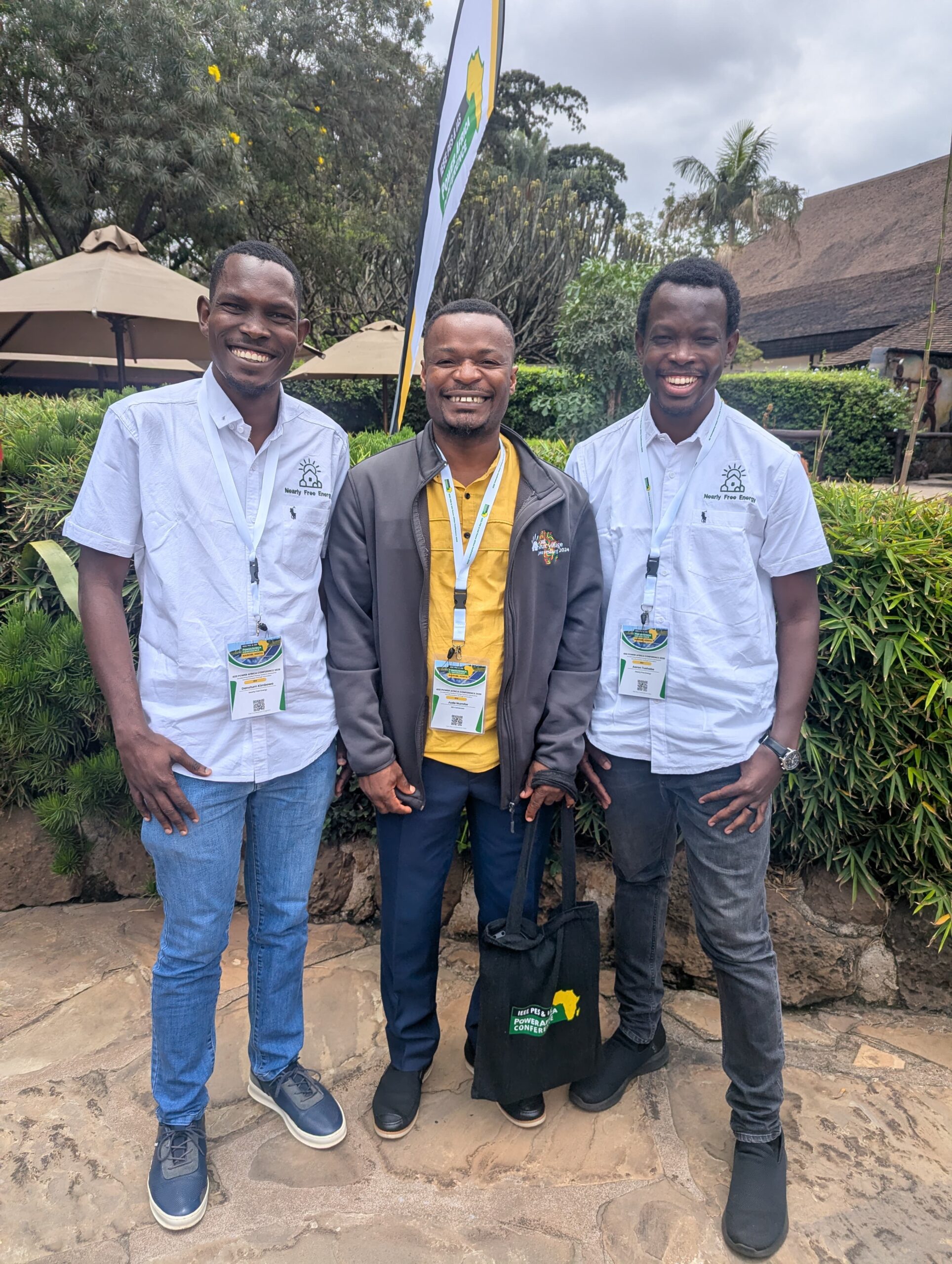
    Nearly Free Energy team members at IEEE Smart Village at PowerAfrica 2026 in Nairobi.
    NFE Co-founders (Dansturn and Aaron) with REI Cameroon’s Jude Numfor at IEEE Smart Village at PowerAfrica 2026 in Nairobi.

    Learning from entrepreneurs who have already scaled

    One of the most valuable parts of the week was connecting with experienced African energy entrepreneurs, including Jude from REI Cameroon and Ifeanyi from GVE Nigeria. Both were generous with their time and willing to share practical lessons from building energy businesses in their respective markets.

    Jude, in particular, challenged the way we were thinking about growth. His advice was simple but important: it can be far more cost-effective to build a strong pipeline of projects than to develop and deploy one project at a time. That conversation has already influenced NFE’s strategy for scaling beyond our first microgrid. We are acting on that lesson today by putting more emphasis on developing a portfolio of qualified communities and projects rather than waiting to complete one deployment before preparing the next.

    We are extremely grateful to Jude, Ifeanyi and IEEE Smart Village for creating an environment where this kind of practical peer learning could happen. For an early-stage energy venture, access to founders who have already travelled this road can be as valuable as access to capital.

    A clearer pathway for long-term partnership with IEEE Smart Village

    We also learned first-hand about IEEE Smart Village’s support and funding pathway for ventures aligned with its core pillars of Electrification, Education and Enterprise. What stood out to us was the rigor of the process. This is not simply a grant application; ventures are expected to demonstrate technical readiness, sustainable enterprise models, community impact, governance and a credible path to growth.

    That is exactly the kind of long-term partnership NFE needs at our current stage. We are not only looking for capital to buy equipment. We need partners who can help us strengthen the enterprise, challenge our assumptions, improve our technical approach and prepare the model for replication. Following PowerAfrica 2026, NFE is now preparing to pursue the IEEE Smart Village enterprise funding pathway.

    Metering 3.0 moved from an idea to something people could hold

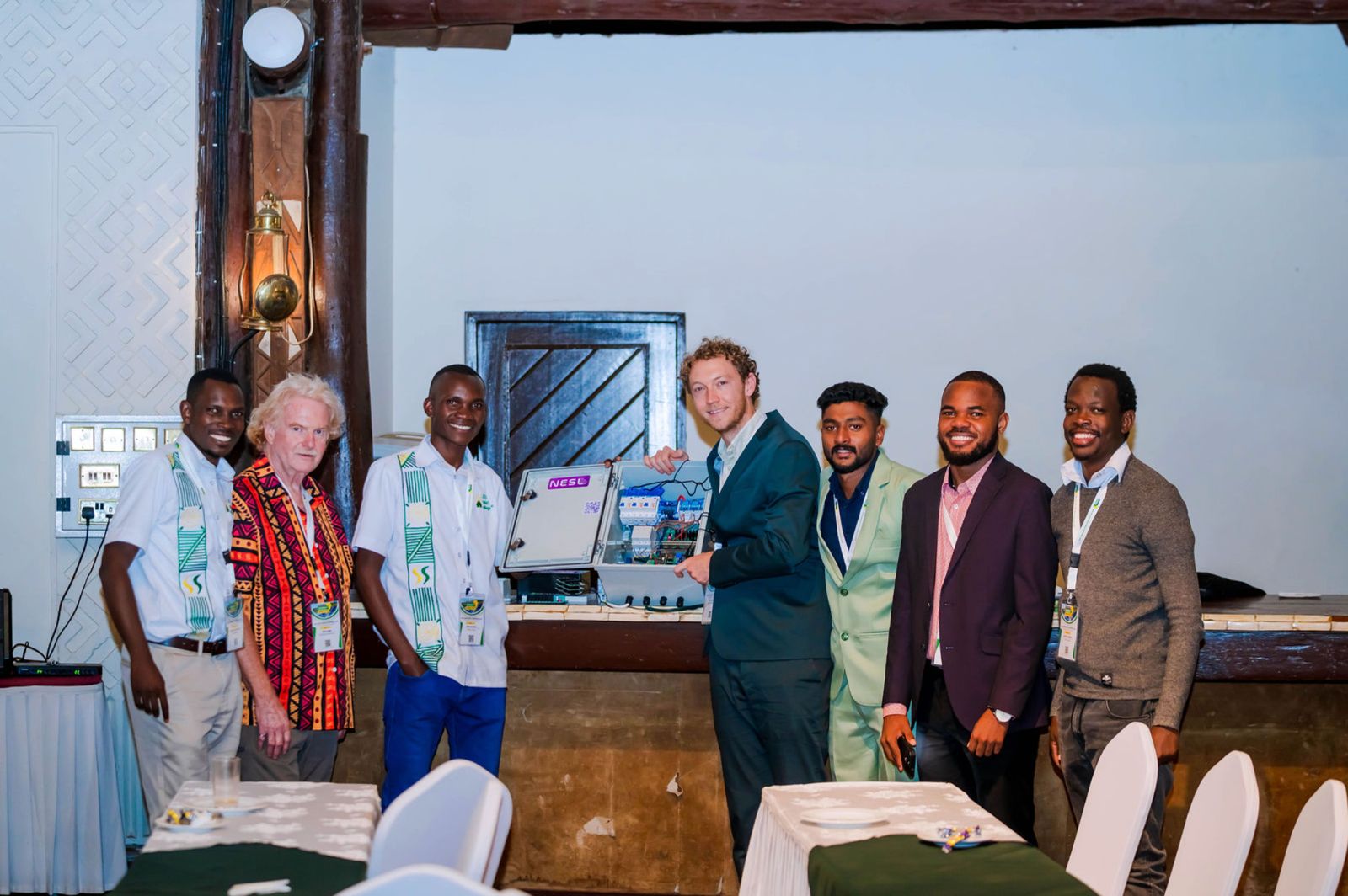
    NFE and collaborators with prototype Metering 3.0 hardware during PowerAfrica 2026.
    NFE and collaborators demonstrating prototype Metering 3.0 hardware at PowerAfrica 2026.

    Another highlight was demonstrating our Metering 3.0 hardware collaboration with the IEEE Smart Village Technology Committee. This work is part of a longer metering journey for NFE.

    We started with Generation 1: Calinmeter hardware sourced from China, paired with proprietary software. Our current pilot has moved to Generation 2: locally purchased CHINT meters integrated with open-source software and open protocols. Generation 3 goes further. The goal is open hardware, open firmware and open software, with equipment that can increasingly be assembled, maintained and repaired in-country.

    The response at the workshop was encouraging. Fifteen participants picked up prototype EMS boards to test in their own projects. For us, that was an important signal that this work can be useful beyond NFE’s own deployments. Open, locally maintainable metering infrastructure has the potential to reduce vendor dependence while building technical capability within the markets where these systems operate.

    Our next commitment is practical: NFE plans to deploy Metering 3.0 at our pilot microgrid before the end of Q4 2026. That deployment will give us a live environment in which to test the hardware, software and operating model together.

    What this means for NFE

    PowerAfrica reinforced something we have been learning through our work in Uganda: the energy challenge is increasingly about reliability, not only access. Many communities already have a grid connection but still cannot confidently depend on power being available when they need it.

    NFE’s Reliable Power Microgrids are our response to that problem. At Sezibwa Rental Homes in Nansana, we have already progressed from smart metering and energy data collection to battery-backed reliability. The next steps are solar integration, a stronger local-energy backbone, continued development of the Microgrid OS, and the transition toward Metering 3.0.

    But the biggest lesson from Nairobi was that scaling will require more than technology. It will require a pipeline of communities, experienced mentors, open technology collaborators and patient financing partners. That is why our relationship with IEEE Smart Village matters to us.

    We left PowerAfrica 2026 with clearer priorities, new relationships and practical actions already underway. We are grateful to IEEE Smart Village for the invitation, for the opportunity to contribute, and for connecting NFE to a community of entrepreneurs and technologists who are building the future of energy access and reliability across Africa.

  • Go-live: Pilot at Sezibwa Rental Homes, Phase 2.0

    In September 2025, we went live with Phase 1.0 of our Reliable Power Microgrids (RPMs).

    There have been several iterations to that phase that we deployed since. For example, in March 2026, we migrated to a locally sourced Smart Meter whose registers the vendor willingly made available to us for integration with our own software stack rather than being locked into their proprietary stack. This was also a huge milestone, Phase 1.5 if you will.

    As a refresher, here’s our four phase microgrid cultivation blueprint to get a sense of the goals of each phase.

    However this post is mostly about a major iteration from Phase 1 – Sub metering to Phase 2 – Backup but I will highlight iterations of phase 1 that I did not get a chance to share about earlier.

    The main change here is that we have deployed battery capacity that serves as a backup during grid outages. For the rest of this update, I will follow a similar format to the first one.

    Metering 2.0

    As of March 2026, we decommissioned the wirelessly connected Calin Meters and deployed the wired (RS485) Chint Smart meters. The connectivity to these has been more reliable for two reasons.

    • Wired communication is less vulnerable to wireless interference and far cheaper for meters that are already clustered in a single location.
    • We now control the software (OpenEMS) that is communicating to the meters.

    To achieve the integration with OpenEMS, we made our first contribution to the open source project by writing the drivers for both three and single phase Chint Meters. We are very proud of this contribution.

    Storage 2.0

    We deployed two 5.12 kWh LFP batteries and a 12 kW three phase hybrid inverter manufactured by SRNE. This was locally sourced, we learned our lesson with the smart meters. Ideally, this site would be best served with a 15 kWh or 20 kWh battery pack but we have to start from somewhere and our partners over at Energy IoT were able to donate the 10 kWh battery pack so we made use of that.

    To achieve the integration with OpenEMS, we also wrote drivers for the SRNE hybrid inverter. That driver is still under testing and review by the maintainers and is yet to be published to the main project. You are still welcome to test and inspect it via NFE’s OpenEMS fork.

    Tech Stack

    Metering: Din rail mounted. DDSU666 – Single phase and DTSU666 – Three phase.

    Connectivity: Daisy chain connection with twisted pair wires to RS485 (A&B) meter terminals via Modbus RTU interface to a Raspberry Pi 4B connected to LTE wireless internet router.

    AMI: OpenEMS

    Communication: Whatsapp for customer support and email for system notifications. NFE customer app for realtime meter readings for customers.

    Billing: Invoicing managed via Energy IoT’s Metering and Billing Engine. VAT reporting done via EFRIS. Monthly postpaid payments via Pesapal (Mobile Money, Visa/Mastercard).

    Finances: We are tracking our spending and inflows (contributions and income) via Open Collective here and internally via Zoho accounting software.

    Documentation: Most information about this microgrid is available on our public Wiki here.

    Present Challenges

    Funding this work has been tough, applying for grants has not yet yielded the results we expected. We are exploring debt financing as well as equity. These funding challenges have also delayed our expansion to more customers.

    Next Release: Phase 3

    Backup to Backbone: We are ready to add solar capacity (and probably battery capacity) so that we can make solar + battery the main power source for this community and have the grid as a secondary source. This change would move the economics of operating this microgrid from the current 10% to 20% monthly margins to 40% to 55% which would allow the project to break even in about 3 years on storage assets that will last 15 to 20 years.

    CRM: We are currently undecided here, we see the value a mature project like MPM offers while we also appreciate the rapid growth of MBE and its narrower focus on products like ours. We are yet to decide which one we’ll stick with but either way, we are glad to have open source options and will seek to integrate either of them with EFRIS soon.

    Metering 2.5: We currently don’t have a way to remotely shut power on/off which creates additional costs for a postpaid billing model and blocks the possibility of supporting prepaid billing soon. We’d like to integrate an off the shelf locally sourced smart relay to effect this. Our experiments at Open Energy Hackathon 2.0 showed us that this is very feasible.

    The Team

    • All this was made possible by the dedicated team at NFE. Dansturn, Hillary, Daphine, and Dismas, thank you.
    • Our partners at Energy IoT also funded Phase 2 and were the brains behind MBE. Alejandro, Arila, Guru, Redwan and all the other volunteers, you have been phenomenal. Thank you so much
    • The folks at IEEE Smart Village, OSEA and EnAccess, USEA, thank you for all the support.

    For more on this project, you can connect with the NFE team via our public channel on Matrix or receive our quarterly progress updates via our community mailing list.

    You can also make contributions to the project to support phase 2 via Open Collective here.

  • Why the Next Energy Access Frontier Is Reliability.

    Why the Next Energy Access Frontier Is Reliability.

    For more than a decade, the global energy access community has rightly celebrated one of development’s major achievements: the steady decline in the number of people living without electricity.

    In 2010, roughly 1.2 billion people had no access to electricity. By 2020, that number had fallen to about 733 million. The latest global tracking reports show further progress, with about 666 million people still without basic electricity access in 2023. That progress matters. It represents hundreds of millions of households gaining light, phone charging, radio, refrigeration, digital connectivity, and the possibility of participating more fully in modern life.

    But it also hides a second story.

    Many people who are now counted as having electricity are still living with power that is too unreliable to transform their lives, businesses, schools, clinics, or communities. They are connected, but not truly served. Their homes have meters, but their evenings are still interrupted by blackouts, and they cannot rely on electricity for critical activities such as cooking. Their businesses are “electrified,” but they still need diesel generators. Their clinics may be connected to the grid, but still cannot rely on power for cold chains, lighting, diagnostics, or emergency care.

    Energy access is not a switch

    Too much of the global conversation still treats electricity access as a binary question: does a household have a connection or not?

    That definition was useful when the most urgent task was extending first-time access. But it is no longer enough. A household that receives power for a few unpredictable hours a day is not in the same position as a household with affordable, stable, 24-hour electricity. A small business that loses power several times a week is not meaningfully “energy secure” simply because it has a grid connection.

    The Sustainable Development Goal itself is broader than connection. SDG 7 calls for access to “affordable, reliable, sustainable and modern energy for all.” Reliability is not a footnote. It is part of the promise.

    The World Bank’s Multi-Tier Framework makes this point clearly. It treats electricity access as a spectrum of service, not a yes-or-no condition. It considers dimensions such as capacity, duration, reliability, quality, affordability, legality, and safety. This is a better way to think about the problem because energy is not valuable merely because a wire reaches a home. It is valuable when power is available, usable, affordable, and dependable enough to support real life.

    The hidden reliability gap

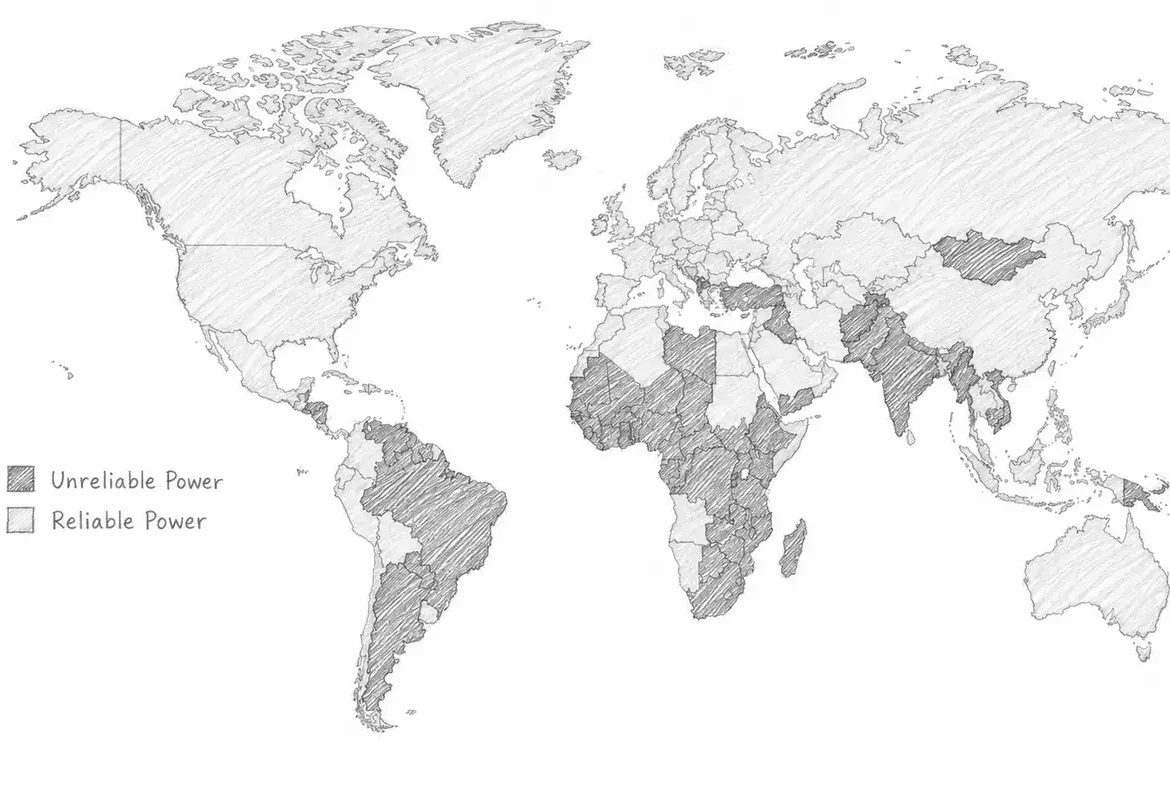
    A 2020 peer-reviewed paper by John Ayaburi, Morgan Bazilian, Jacob Kincer, and Todd Moss estimated that approximately 3.5 billion people lack access to “reasonably reliable” electricity services. Their approach defined reasonable reliability as no more than one outage, or one hour of outage, per month on average.

    That figure is striking because it reframes the energy access challenge. The world does not only have a problem of hundreds of millions of people without any electricity. It also has a problem of billions of people whose electricity is too unreliable to meet the ambition of SDG 7.

    This distinction matters for policy and investment. If we only count connections, the global access story can look like a story of steady success. If we count reliability, the story becomes more urgent: many countries have expanded access faster than they have strengthened the grids that serve those new customers.

    The result is a growing class of communities that are technically connected but still energy poor.

    The communities in the middle

    Our work at Nearly Free Energy focuses on these communities in the middle.

    They are not always the remote, off-grid villages that dominate traditional energy access imagery. Many are urban and peri-urban communities. They are near the grid. They may already pay utility bills. They may have poles, transformers, meters, and national grid supply. But they also experience frequent outages, voltage problems, transformer overloads, rationing, or long restoration times after faults.

    For these communities, the problem is not absence of infrastructure. The problem is insufficient reliability.

    This is especially important in fast-growing cities and peri-urban areas across Africa. Demand is rising quickly. Households are adding appliances. Small businesses need refrigeration, welding, milling, printing, charging, internet access, and productive equipment. Apartment communities and estates are becoming denser. Electric mobility, water pumping, cold storage, security systems, and digital services all depend on electricity that works when needed.

    A weak connection cannot support this future.

    How grid-connected microgrids address the gap

    The traditional energy access toolkit often divides the world into two categories: grid extension for connected areas and off-grid or mini-grid solutions for remote communities. But this leaves out a major opportunity: grid-connected microgrids for communities that already have access but not reliability.

    A grid-connected microgrid can strengthen a community from the edge of the grid inward. It can combine solar, battery storage, smart meters, controls, and the existing grid connection into a local energy system that improves reliability without abandoning the national grid.

    This approach strengthens the main grid by treating it as one input into a more resilient local energy system.

    When the grid is available, the community can use it. When the grid fails, the microgrid can keep essential loads running. When solar is producing, the community can reduce dependence on expensive and unstable supply. When batteries are charged, evening peaks and short outages can be managed locally. With smart metering and software, the community can see demand, manage consumption, collect payments, and plan upgrades over time.

    In this model, microgrids are not only a tool for first-time access. They are a tool for reliable access.

    Reliability is economic development

    Reliability is not just a technical metric. It is a development outcome.

    Unreliable power changes how people live and how businesses operate. It raises costs, reduces productivity, damages equipment, limits working hours, disrupts learning, weakens health services, and pushes households and businesses toward diesel generators and other expensive backup options.

    A shopkeeper who cannot refrigerate drinks or food reliably loses income. A salon that cannot depend on power loses customers. A clinic that cannot maintain cold storage carries risk. A student who cannot study after dark loses opportunity. A residential estate that cannot pump water, run security systems, or power shared services experiences lower quality of life even though it is “connected.”

    This is why the energy access community should treat reliability as central, not secondary.

    The goal should not be to connect people to weak power systems and declare success. The goal should be to deliver electricity services that are good enough to change what households, businesses, and communities can actually do.

    The investment gap is also a measurement gap

    One reason the reliability problem receives too little attention is that it is poorly measured.

    Most global access dashboards are better at counting whether people have basic electricity access than at measuring whether the power they receive is dependable. The Energy for Growth Hub has argued that standard access metrics do not adequately capture the qualitative aspects of modern electricity service. The Ayaburi, Bazilian, Kincer, and Moss paper was important because it attempted to quantify this hidden gap.

    But the bigger lesson is not only the 3.5 billion estimate. The bigger lesson is that what we measure shapes what we build.

    If we measure only new connections, institutions will optimize for new connections. If we measure reliable service, we will begin to finance and regulate systems that improve reliability, resilience, and quality. That means better utility performance, stronger distribution networks, smarter metering, distributed generation, battery storage, local energy management, and new business models for communities that are already connected but underserved.

    The opportunity for advancing access through reliability 

    Nearly Free Energy’s mission is to advance energy access by focusing on the reliability gap.

    We believe the next major frontier in energy access is not only reaching the last unelectrified households, important as that remains. It is also upgrading millions of weak-grid communities from nominal access to meaningful access.

    Our focus is grid-connected microgrids for urban and peri-urban communities on unreliable national grids. These communities are close enough to the grid to benefit from it, but exposed enough to need local resilience. They do not need to wait for perfect national grid reliability before improving their lives. They can begin building reliability at the community level now.

    This is a practical, scalable, and complementary approach. It can reduce dependence on diesel backup. It can improve customer experience. It can support productive use of electricity. It can relieve stress on local transformers and distribution infrastructure during peak periods. It can create better data on consumption and outages. And, when designed well, it can become a platform for future services such as electric mobility, water pumping, cold storage, internet infrastructure, and community-level energy planning.

    From access to adequacy

    The energy access movement has achieved a great deal by expanding the number of people connected to electricity. That work must continue. Hundreds of millions of people still lack even basic access, and they should remain a global priority.

    But the next chapter must be more ambitious.

    We should ask not only, “Is this household connected?” but also:

    • Can the household rely on power in the evening?
    • Can children study when they need to?
    • Can businesses operate without diesel backup?
    • Can clinics maintain essential services?
    • Can communities power water, security, refrigeration, and communications?
    • Can the local grid support growth rather than constrain it?

    These are the questions that move us from access to adequacy.

    The world has made real progress in reducing the number of people without electricity. But if billions remain connected to power they cannot rely on, then the mission of SDG 7 is still unfinished.

    The future of energy access must be reliable, affordable, sustainable, and local enough to meet communities where they are.

    That is the opportunity for grid-connected microgrids.

    And that is the mission Nearly Free Energy is advancing.

    How to fund our work.


    References

    1. Ayaburi, J., Bazilian, M., Kincer, J., & Moss, T. (2020). Measuring “Reasonably Reliable” access to electricity services. The Electricity Journal, 33(7), 106828. https://doi.org/10.1016/j.tej.2020.106828
    2. International Energy Agency (IEA), International Renewable Energy Agency (IRENA), United Nations Statistics Division (UNSD), World Bank, and World Health Organization (WHO). (2022). Tracking SDG 7: The Energy Progress Report 2022. https://www.iea.org/reports/tracking-sdg7-the-energy-progress-report-2022
    3. World Health Organization (WHO), International Energy Agency (IEA), International Renewable Energy Agency (IRENA), United Nations Statistics Division (UNSD), and World Bank. (2025). Tracking SDG 7: The Energy Progress Report 2025. https://www.who.int/publications/m/item/2025-tracking-sdg7-report
    4. Bhatia, M., & Angelou, N. (2015). Beyond Connections: Energy Access Redefined. Energy Sector Management Assistance Program (ESMAP), World Bank. https://www.esmap.org/node/55526
    5. Energy for Growth Hub. (2020). 3.5 Billion People Lack Reliable Power. https://energyforgrowth.org/article/3-5-billion-people-lack-reliable-power/
    6. United Nations. Sustainable Development Goal 7: Ensure access to affordable, reliable, sustainable and modern energy for all. https://sdgs.un.org/goals/goal7