In September 2025, we went live with Phase 1.0 of our pilot at Sezibwa Rental Homes: smart sub-meters and NFE billing for 10 homes on one UEDCL commercial meter. In late July 2026 came Phase 2.0, a 10 kWh battery and a hybrid inverter that keep the homes powered through grid outages. On 26 October 2026, we connected Phase 3: 4.8 kWp of rooftop solar.
As a refresher, our microgrid cultivation blueprint grows a microgrid one layer at a time: Monitor, Backup, Backbone, then Community Power Plant. Each step is proven with data before the next. In the Phase 2 post, we said we were ready to add solar so that solar plus battery could become this community’s main power source, with the grid as the backup. This release is the first step on that road. We are not at Backbone yet, and I’ll explain why below. As before, I’ll follow the same format.
Smart charging (Phase 2.5, if you will)
One iteration of Phase 2 is worth sharing first. Since 26 September 2026, the battery charges at the cheap night rate and powers the homes through the expensive evening peak. Over 40 nights it moved 183 kWh of the site’s use from the evening peak to the night rate, saving about UGX 34,500 on the bulk power bill.
Solar 1.0
We installed eight 600 W panels in a single row on the north-west face of the roof. Sezibwa sits less than half a degree north of the equator, so the sun is almost overhead all year and the direction a roof face points makes little difference: modelled output for the four faces differs by only about 2%. The trees decided it. Tall trees stand on most sides of the house, and the north-west face looks away from most of them.
All eight panels are wired in one series string into the SRNE hybrid inverter we installed in Phase 2. Two strings of four would have run at about 155 to 180 V, below the inverter’s 200 V minimum, so one string it is. The trade-off is that shade on one panel pulls down all eight, so Dismas cleared the vegetation around the array. At commissioning on the afternoon of 26 October, the string read 379 V with no load: all eight panels in series and none connected backwards.
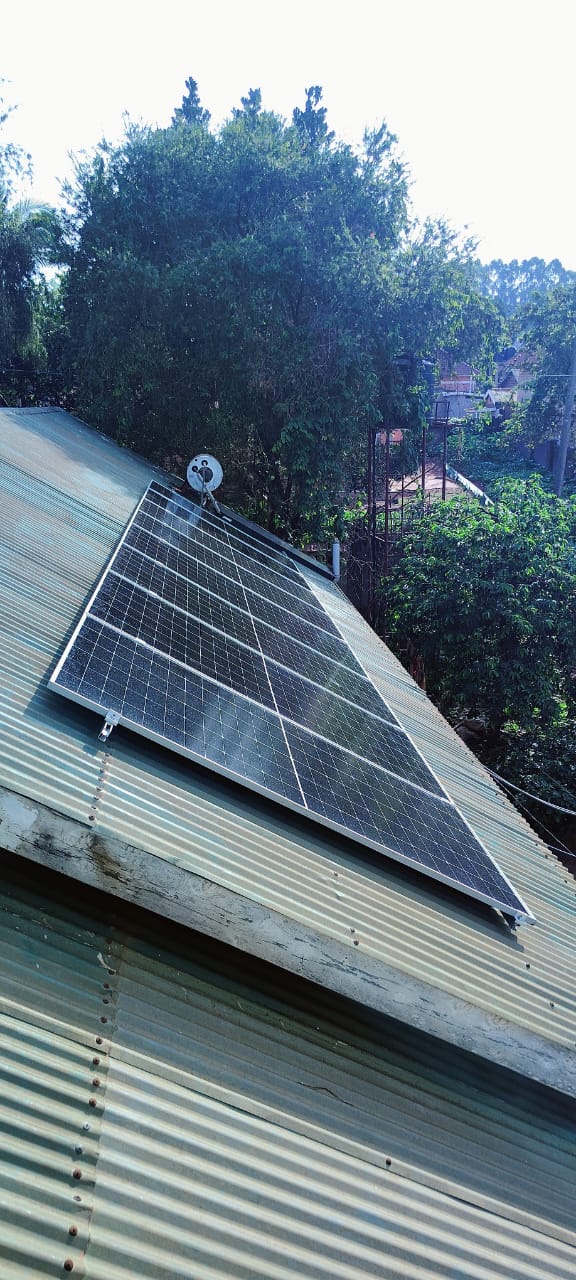
What should it produce? Our model for this roof gives about 19.5 kWh of solar on an average day (15 to 18 kWh in rainy weeks), or about 6,780 kWh a year. The homes use about 28 kWh a day, measured from 19 to 25 October, so solar alone can’t run the site. The plan is for solar to serve the homes during the day and fill the battery, for the battery to carry the evening peak, and for the grid to top up at the cheap night rate. On a good day, we expect solar and battery together to supply about 65% of the load.
First results
- The first two days were cloudy. The panels produced 4.5 kWh on 27 October and 4.6 kWh on 28 October, well below plan. The best days up to 2 November produced 13 and 15 kWh, against 12 to 18 kWh expected in the rainy season. It’s too early to judge the installation, so we’re collecting more data before we do.
- The daily figure understates the panels. The site can’t export to the grid, so solar can only go into the homes and the battery. When both are satisfied, the rest goes unused.
- The grid’s night charge fell 42% in the first days, because the battery now leaves room for the sun. The sun refills it by late morning: on 28 October it went from 75% to 99% by 11:36.
Reliability
Between 25 August and 8 November 2026, the grid at Sezibwa failed 86 times, for 128 hours in total: about 1.7 hours a day. Residents kept their power through about 90% of those outage hours. October was the best month so far, with 96% of 77 outage hours covered, including a six-hour night cut on 11 October that the battery carried with 60% charge to spare.
With solar and new controller settings, we’re targeting 99% coverage. The last few days have been at 96 to 100%. That’s a target, not a result yet, and the next section explains why.
Present Challenges
Settings that think: Between 29 October and 5 November, we trialled a solar-first setting, where the inverter serves the homes from solar first, then the battery, then the grid. On some days the battery ran down to its reserve before an evening cut, and homes lost power for up to two hours. That pulled coverage since solar went live (26 October to 9 November) down to 85%. Hand-tuning settings doesn’t scale, so we’re replacing fixed settings with a controller that plans each day from the weather forecast, the last seven days of site data and the outage pattern. Its first rule: residents never lose power.
Trees: The array shares its view of the sky with some very tall trees. Because the eight panels share one string, we’ll watch the output month by month for signs of shade.
Tech Stack
What’s new since Phase 2:
Solar: 8 × Golden Sun GS600N-144M 600 W monocrystalline panels, 4.8 kWp, flush-mounted on aluminium rails in one series string.
Protection: 32 A 4-pole DC isolator and 1000 V DC surge protector between the array and the inverter, with 6 mm² PV cable.
Inverter and storage: the SRNE ASP48120SH3 12 kW three-phase hybrid inverter and two 5.12 kWh LFP batteries from Phase 2. The array uses one of the inverter’s two PV inputs, so there’s room for more panels.
Control: OpenEMS on a Raspberry Pi 4B, which records the grid and home supply every 5 minutes.
Documentation: Most information about this microgrid is available on our public Wiki here.
Next Release
Settings that think: the goal-driven controller described above, so the site picks its own settings each day.
A measured number: after a few more weeks of solar data, we’ll replace the 99% target with a measured figure and share it here.
Garuga: the next phase takes what we’ve learned in Nansana from 10 households to about 100 in Garuga, with more battery and solar capacity, an open-hardware controller and a step towards Backbone.
The Team
- Dansturn, Hillary, Daphine and Dismas, thank you. Dismas was on site through the installation and took the photo in this post.
- Green Volta installed the array, and Muden Systems supplied the panels and mounting hardware.
- The tenants at Sezibwa Rental Homes, who started telling each other when the site switched to battery so everyone could ease off heavy appliances and make the backup last longer.
- Our partners at Energy IoT, and the folks at IEEE Smart Village, OSEA, EnAccess and USEA, thank you for your continued support.
For more on this project, you can connect with the NFE team via our public channel on Matrix or receive our quarterly progress updates via our community mailing list.
You can also make contributions to the project to support the next phase via Open Collective here.
Leave a Reply